
WHAT ARE EXPANSION BELLOWS
PROPERTIES, BENEFITS AND USES
WHAT ARE EXPANSION BELLOWS
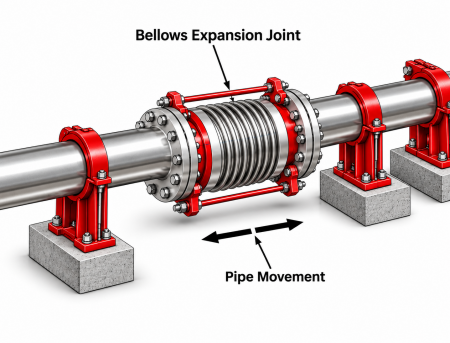
They are flexible components installed within a pipework system to accommodate movement. They consist of one or more convolutions that allow the unit to compress, extend or flex as the system moves. This flexibility relieves stress that would otherwise be transferred directly into rigid pipework and equipment.
They are designed to absorb several different types of movement:
- Axial movement – expansion and contraction along the pipe axis
- Lateral movement – movement perpendicular to the pipe
- Angular movement – bending or rotational movement between connected components
- Combined movement – where multiple movement types occur simultaneously
By accommodating these movements, expansion bellows help prevent damage to pipework, pumps, valves, turbines and other critical equipment.
PROTECT PIPEWORK FROM MOVEMENT AND STRESSS
Industrial pipework systems are subjected to constant forces. Temperature changes cause pipes to expand and contract, pumps generate vibration, and equipment movement can place additional stress on connections. Without the right safeguards in place, these forces can lead to leaks, fatigue, equipment damage and costly downtime. This is where expansion bellows play a critical role. Also known as expansion joints or compensators, expansion bellows are designed to absorb movement within a piping system, protecting both the pipework and connected equipment from excessive stress. Whether used in power generation, chemical processing, food production or marine applications, they are an essential component in maintaining safe and reliable operations.
WHY THERMAL EXPANSION MATTERS
One of the most common reasons for installing expansion bellows is thermal expansion. As pipework heats up, it expands. In long pipe runs, even relatively small temperature changes can create significant movement. If that movement is restricted, stress can build up within the system, leading to:
- Cracked welds
- Distorted pipework
- Damaged supports and anchors
- Premature equipment failure
- Increased maintenance costs
They absorb this movement safely, allowing the system to expand and contract without placing excessive loads on surrounding components. Thermal movement is only part of the challenge. Many industrial systems also generate vibration. Pumps, compressors, turbines and rotating machinery all create vibration that can travel through connected pipework. Over time, this can contribute to fatigue failures and increased wear on equipment. Expansion bellows act as flexible connectors within the system, helping to isolate and absorb vibration before it causes damage. In many applications, they also reduce transmitted noise, improving both equipment performance and working conditions.
TYPES OF EXPANSION BELLOWS
Different applications require different bellows materials and designs.
STAINLESS STEEL EXPANSION BELLOWS
Stainless steel versions are widely used in demanding industrial environments where pressure, temperature and chemical resistance are critical.
They are commonly found in:
- Power generation facilities
- Petrochemical plants
- Process industries
- Marine applications
- Industrial heating systems
Available in a wide range of sizes and pressure ratings, stainless steel bellows can be supplied as simple single-bellows units or more complex restrained, hinged, tied and pressure-balanced designs.
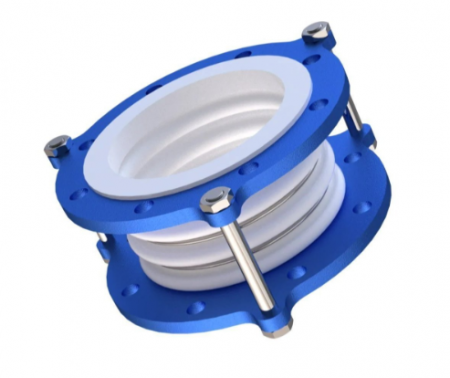
PTFE EXPANSION BELLOWS
PTFE versions are particularly suited to applications involving highly corrosive media or where cleanliness and product purity are essential.
Their excellent chemical resistance makes them popular within:
- Chemical processing
- Pharmaceutical manufacturing
- Food and beverage production
- Water treatment
PTFE bellows can also be designed to protect fragile equipment by reducing the transfer of stress and vibration through the system.
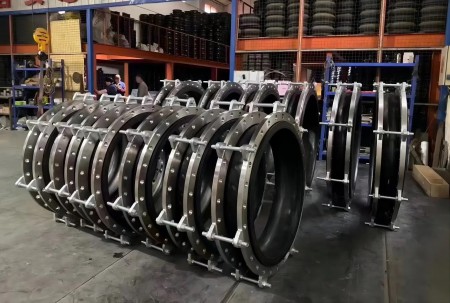
RUBBER EXPANSION BELLOWS
Rubber bellows offer excellent vibration isolation and noise reduction characteristics.
They are commonly used in:
- HVAC systems
- Water treatment facilities
- Pump installations
- Marine systems
- General industrial pipework
They are capable of absorbing axial, lateral and angular movement while providing effective protection against vibration and pressure fluctuations.
CHOOSING THE RRIGHT EXPANSION BELLOW
Selecting the correct expansion bellows requires careful consideration of the operating conditions.
Factors include:
- Pipe size
- Operating pressure
- Temperature range
- Type and amount of movement
- Media compatibility
- Installation constraints
- Required service life
Because every application is different, many expansion bellows are custom designed to suit the specific requirements of the system. The correct design ensures the bellows can safely accommodate movement while maintaining long-term reliability. Expansion bellows are often overlooked, but they play a vital role in the performance and longevity of industrial pipework systems. By managing thermal expansion, absorbing vibration and accommodating movement, they help prevent failures, reduce maintenance costs and protect valuable equipment. When properly specified and installed, expansion bellows contribute significantly to safer, more efficient and more reliable operations.

REQUIRE MORE INFORMATION?
Send an e-mail to sales@resistochem.co.za for our full catalogue of PVDF products.